Introduction
Socializing a reactive dog can feel challenging, especially when your dog barks, lunges, growls, freezes, or becomes overly excited around other dogs. However, reactivity does not mean your dog is aggressive or incapable of social interaction. With patience, careful planning, and consistent training, many reactive dogs can learn to remain calm around other dogs.
Learning how to socialize a reactive dog with other dogs safely starts with understanding your dog’s emotional response. Instead of forcing interactions, you should create situations where your dog feels secure. The goal is not necessarily to make your dog play with every dog they meet. Instead, successful socialization teaches your dog that seeing another dog does not require an intense reaction.
Understanding Why Dogs Become Reactive
Dog reactivity can develop for several reasons. Fear, frustration, lack of social experience, previous negative experiences, and overexcitement can all contribute. Some dogs react because they feel trapped when another dog approaches.
For example, a dog may bark aggressively from behind a fence. However, that same dog might behave differently when given enough space. Therefore, context matters when evaluating reactive behavior.
Genetics and temperament can also influence reactivity. Some dogs naturally have lower tolerance for unfamiliar animals or stimulating environments. Others become reactive after a frightening encounter.
Understanding the reason behind the reaction helps you choose an appropriate training approach. However, identifying the exact cause can be difficult without professional assessment.


What Does Reactivity Look Like?
A reactive dog may show several noticeable behaviors around other dogs. Barking and lunging are common signs, but they are not the only ones.
Your dog might stare intensely, pull toward another dog, growl, whine, freeze, hide, or repeatedly turn their head. Some dogs become extremely excited and struggle to respond to familiar commands.
Body language can provide important clues. A stiff body, raised hackles, closed mouth, hard stare, or tense posture may indicate increasing arousal.
Learning these early signals is important. Once your dog reaches a high level of arousal, learning becomes much harder. Therefore, successful socialization begins before the reaction becomes intense.
How to Socialize a Reactive Dog with Other Dogs Safely
The safest approach involves gradual exposure rather than direct interaction. Start at a distance where your dog notices another dog but can still think and respond to you.
This distance is sometimes called the dog’s threshold. Every dog has a different threshold, and it can change depending on the environment, other dog’s behavior, and your dog’s emotional state.
Begin by finding a quiet location with plenty of space. When your dog notices another dog, calmly reward them for remaining relaxed. You can use small, high-value treats that your dog particularly enjoys.
Over time, your dog can learn that seeing another dog predicts something positive. This changes the emotional association without forcing physical contact.
Start with Distance and Control
Distance is one of the most useful tools when working with a reactive dog. If your dog reacts strongly at 20 feet, begin farther away.
Choose open spaces where you can move away easily. Avoid narrow paths where another dog could suddenly approach.
Keep your dog’s leash secure without maintaining constant tension. A tight leash can sometimes increase frustration or make your dog feel restricted.
As your dog becomes more comfortable, gradually decrease the distance. However, do not rush this process. If your dog reacts, increase the distance again and allow them to recover.
The goal is calm exposure, not maximum exposure.
Teach Attention Before Introducing Other Dogs
Before practicing around dogs, teach your pet to focus on you in low-distraction environments. Simple cues such as their name, “look,” or a hand target can become valuable communication tools.
Practice indoors first. Then move to a quiet outdoor area before introducing more distractions.
Reward your dog whenever they voluntarily check in with you. This creates a habit of looking toward you when something interesting appears.
When another dog eventually enters the environment, your dog has a familiar behavior to perform. That can make challenging situations easier to manage.
Use Positive Reinforcement
Positive reinforcement is particularly useful for changing emotional responses. Reward behaviors you want to see rather than punishing reactions after they occur.
For example, imagine your dog sees another dog across a park. Your dog looks at the other dog and then looks back at you.
Immediately reward that choice. With repetition, your dog can learn that calmly noticing another dog brings valuable rewards.
Food is often effective, but rewards can vary. Some dogs enjoy toys, praise, sniffing opportunities, or moving away from a stressful situation.
The best reward is the one your individual dog finds motivating.
Practice Parallel Walking
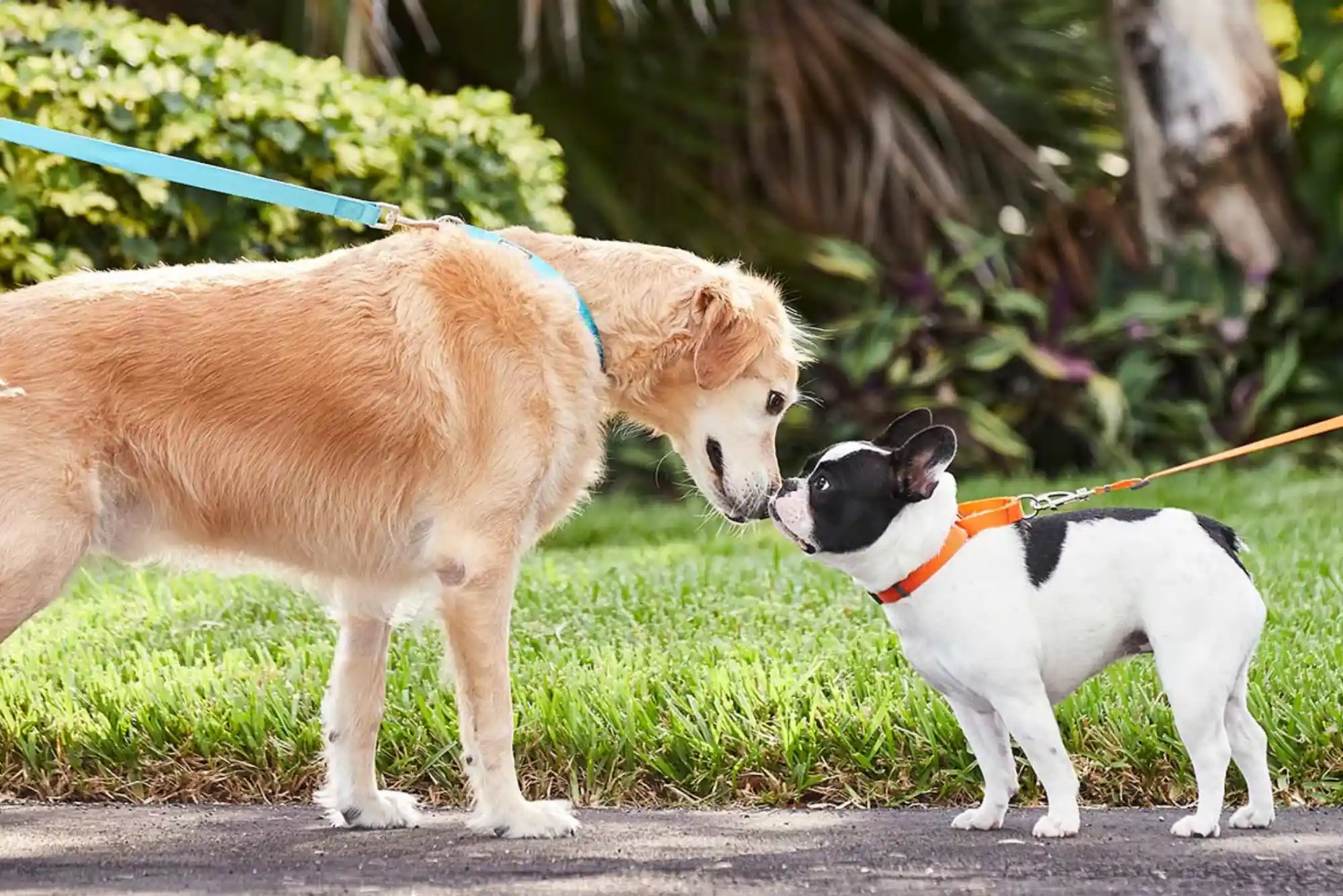
Direct face-to-face greetings can create unnecessary pressure. Parallel walking is often a more controlled alternative.
Ask a calm, familiar dog and handler to help with training. Start with plenty of space between the dogs. Both dogs should walk in the same general direction.
Keep the sessions relaxed. There is no requirement for the dogs to greet each other.
As both dogs remain comfortable, the distance can gradually decrease. If either dog becomes tense, increase the space again.
Parallel walking allows dogs to become familiar with another dog’s presence without the intensity of direct interaction.
Choose the Right Dog for Practice
Not every dog is suitable as a training partner. A calm, socially appropriate dog is generally easier to work with than an excitable or highly reactive dog.
A stable training partner should respond appropriately to your dog’s signals. They should also have a handler who understands the importance of maintaining distance.
Avoid using unfamiliar dogs as experimental training partners. A sudden approach can overwhelm your dog and set training back.
Controlled sessions are safer and provide better opportunities for learning.
Do Not Force Dog-to-Dog Greetings
One common mistake is believing that every dog needs to say hello. They do not.
Your dog can live a happy and fulfilling life without greeting every animal they encounter. In fact, teaching neutrality can be more valuable than teaching constant sociability.
A neutral dog can see another dog and continue walking without becoming overwhelmed. This is often the practical goal of reactive dog training.
If your dog becomes uncomfortable during an interaction, calmly create distance. Respecting their communication can prevent escalation.
Watch for Signs of Stress
Successful socialization requires careful observation. Your dog may communicate discomfort before barking or lunging occurs.
Watch for lip licking, yawning, turning away, tucked tails, sudden scratching, freezing, pacing, or avoiding eye contact. These behaviors can indicate stress.
Pay attention to changes in body posture as well. A relaxed dog usually has a softer body and more natural movement.
If you notice several stress signals, give your dog more space. Continuing the exercise can push them beyond their coping ability.
Keep Training Sessions Short
Reactive dog training does not need to last for hours. Short, successful sessions are often more productive.
For example, a few calm exposures may be enough for one session. End the exercise while your dog is still coping well.
Long sessions can cause mental fatigue. A tired dog may have less ability to manage stressful situations.
Consistency matters more than duration. Several brief practices throughout the week can provide useful repetition.
Manage the Environment
Management is an important part of learning how to socialize a reactive dog with other dogs safely. Training works best when you reduce unnecessary opportunities for overwhelming reactions.
Choose quieter walking times when possible. Avoid crowded dog parks if they trigger your dog.
Use visual barriers when necessary. Cars, fences, trees, and buildings can help create temporary distance.
You can also change direction when another dog approaches. There is nothing wrong with avoiding a difficult situation while your dog is learning.
Management does not mean failure. It helps prevent repeated reactions while training progresses.
Consider Professional Support
Some reactive dogs need more individualized help. A qualified force-free trainer or veterinary behavior professional can assess your dog’s behavior and develop a structured plan.
Professional guidance is especially important when reactions involve biting, redirected aggression, severe fear, or unpredictable behavior.
A veterinarian can also help identify medical factors that may influence behavior. Pain and other health problems can sometimes affect a dog’s tolerance and responses.
Choose professionals who use humane, evidence-based methods. Avoid training approaches based on fear, pain, or intimidation.
Common Mistakes to Avoid
Trying to move too quickly is one of the most common mistakes. Dogs need time to process new experiences, and progress is rarely perfectly linear.
Another mistake is focusing only on stopping barking. The deeper goal is helping the dog feel safer and develop better coping skills.
Punishing growling can also create problems. Growling is communication that something is uncomfortable. Suppressing that warning without addressing the underlying emotion can be risky.
Finally, avoid comparing your dog with other dogs. Every dog has a different temperament, history, and learning pace.
How Long Does Socialization Take?
There is no universal timeline for a reactive dog. Some dogs show noticeable improvement within weeks, while others require months of consistent work.
Progress depends on several factors. These include the dog’s history, age, temperament, triggers, environment, and training consistency.
Look for small improvements rather than expecting an immediate transformation. Your dog may recover faster after seeing another dog or react from a slightly shorter distance.
These changes can represent meaningful progress.
Can a Reactive Dog Ever Play with Other Dogs?
Some reactive dogs can eventually interact comfortably with selected dogs. However, play should never be considered the only measure of successful socialization.
For some dogs, calm coexistence is a more realistic and safer goal. Your dog might eventually enjoy playing with one trusted dog while remaining uncomfortable around unfamiliar dogs.
Allow the relationship to develop naturally. Supervise interactions and watch both dogs for signs of stress.
If either dog repeatedly attempts to escape, freezes, becomes excessively tense, or shows threatening behavior, calmly separate them.
Frequently Asked Questions
Can a reactive dog be socialized with other dogs?
Yes, many reactive dogs can improve with gradual exposure and appropriate training. The process should focus on emotional comfort rather than forced interaction.
How do I introduce my reactive dog to another dog?
Begin at a comfortable distance in a neutral, quiet location. Reward calm behavior and consider parallel walking before attempting closer interaction.
Should I let my reactive dog meet other dogs?
Not necessarily. Your dog does not need to greet every dog. Teaching calm behavior around other dogs can be a more useful goal.
How do I stop my dog from barking at other dogs?
Start by increasing distance from the trigger. Reward your dog for calmly noticing another dog and redirecting attention toward you.
Is dog reactivity the same as aggression?
No. Reactivity describes an intense response to a particular trigger. Aggression involves behavior intended to threaten or cause harm. A professional should assess serious cases.
Can a reactive dog live with another dog?
Sometimes, yes. Compatibility depends on the individual dogs, their behavior, environment, and management. Careful introductions are essential.
Conclusion
Learning how to socialize a reactive dog with other dogs safely requires patience, observation, and realistic expectations. The process should not involve forcing your dog into uncomfortable interactions.